





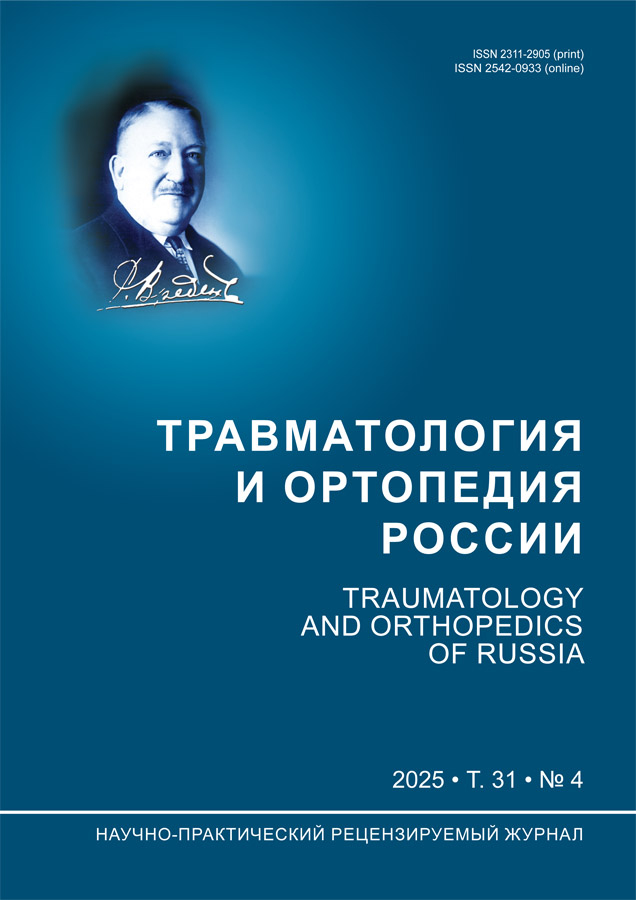
Traumatology and Orthopedics of Russia

The peer-review medical journal was founded in 1993.
Founders
- Vreden National Medical Research Center for Traumatology and Orthopedics (link)
- Eco-Vector Publishing house (link)
Publisher
- Eco-Vector Publishing house (link)
Editor-in-Chief
- Rashid M. Tikhilov, MD, Dr. Sci. (Med.), Professor, corresponding member of the Russian Academy of Sciences
ORCID iD: 0000-0003-0733-2414
About
The journal has been published since 1993 and is the first periodical in modern Russia that provides comprehensive coverage of current problems in traumatology and orthopedics.
The journal's mission is to advance study results to clinical practice in order to improve and enhance trauma and orthopedic care for patients. In collaboration with leading clinicians and researchers, we aim to become the top Russian journal, providing national and international studies based on the principles of evidence-based medicine and increasing knowledge of the musculoskeletal system.
Goals and objectives of the journal:
- to inform Russian and foreign readers about new experimental and clinical studies in traumatology and orthopedics;
- to provide a platform for scientific discussions and consensus building on controversial aspects of diagnostics and treatment of musculoskeletal disorders in adults and children;
- to promote wider cooperation between Russian and foreign specialists in traumatology and orthopedics in order to form a modern trauma and orthopedic practice.
Indexing
- Russian Science Citation Index
- SCOPUS
- Web of Sciences (Emerging Sources Citation Index)
- Google Schoolar
- DOAJ
- BASE
- CyberLeninka
- Dimensions
- NLM
- SocioNet
- VINITY
- Dimensions
- OpenAIRE
Publications
- No APC
- Platinum Open Access
- Distribution with the CC BY-NC-ND 4.0 License
- Quarterly publications
- English and Russian full-text
最新一期
卷 31, 编号 4 (2025)
- 年: 2025
- ##submission.datePublished##: 09.12.2025
- 文章: 17
- URL: https://journal.rniito.org/jour/issue/view/75
- DOI: https://doi.org/10.17816/2311-2905-2025-31-4

Clinical studies
Paprosky type 3B acetabular defects: uniform pattern or spectrum of variants?
摘要
The aims of the study — to identify variants and combinations of acetabular structural damage in patients with Paprosky type 3B defects based on the three-dimensional reconstructions of the pelvis, as well as to determine the degree of heterogeneity among these variants within type 3B defects and the dependence of the formation of different damage variants on various factors.
Methods. The study included 132 patients with Paprosky type 3B acetabular defects who underwent revision total hip arthroplasty. Based on the computer tomography data, three-dimensional reconstructions of the pelvis were created. Acetabular supporting structures were assessed. Each structure was evaluated according to three levels of integrity: anatomically preserved, partially preserved/lytic destruction, and complete loss of support/full defect. The heterogeneity of defect variants was assessed using the Shannon index. The association between identified defect variants and patient-related factors was evaluated using multivariate ordinal logistic regression with calculation of odds ratios for each factor.
Results. Five main variants of acetabular damage within Paprosky type 3B defects were identified. The most common variant was the combination of a complete medial wall defect and an anterior column defect. The normalized Shannon index was 0.91 (H/Hmax), suggesting that, for the five identified variants, the heterogeneity of type 3B defects approaches the maximum possible level. A prior periprosthetic joint infection increased the odds ratios of developing a defect pattern with more extensive involvement of load-bearing structures by nearly 2.5 times, while each additional revision procedure increased the risk by 65%.
Conclusions. At least five distinct variants of acetabular load-bearing element damage within Paprosky type 3B defects can be identified. Among the five identified variants, the diversity approaches its maximal possible level. Significant factors influencing the variant of defect were a history of periprosthetic joint infection and the number of previous revision operations. Mandatory three-dimensional visualization for extensive acetabular defects gives the surgeon a more informative picture of the lost and preserved supporting elements. Mandatory three-dimensional modeling in cases of extensive acetabular defects provides the surgeon with a more informative understanding of the lost and preserved load-bearing structures.
 5-14
5-14


Early diagnosis of aseptic loosening of hip prosthetic components using acoustic arthrometry
摘要
Background. One of the main causes of revision hip arthroplasty is aseptic loosening of prosthetic components. A non-invasive method for early detection of this complication is the assessment of prosthesis condition using a triaxial accelerometer — acoustic arthrometry.
The aim of the study — to evaluate the potential of acoustic arthrometry for early diagnosis of aseptic loosening of prosthetic components and polyethylene liner wear in hip prostheses.
Methods. The study was performed using a custom-designed device for non-invasive registration of vibrational and acoustic oscillations in the area of the implanted joint. Interpretation and analysis of the obtained acoustic signatures were performed using MATLAB software. Acoustic emission recordings were obtained from 120 patients: 40 with diagnosed aseptic loosening of prosthetic components, 40 with polyethylene liner wear, and 40 control patients with no complaints regarding prosthesis function. Predictors of aseptic loosening and polyethylene wear were identified using regression analysis.
Results. In a multivariate risk model of polyethylene liner wear, ROC analysis demonstrated optimal sensitivity (91.7%) and specificity (84.6%) of the proposed method. For diagnosing aseptic loosening of prosthetic components, the sensitivity and specificity were 79.5% and 65.8%, respectively.
Conclusion. Specific acoustic signatures analyzed using the developed evaluation criteria (Peak, Asymmetry, Width) correlated with radiographic findings and showed high specificity (84.6%) and sensitivity (91.7%). These results support the feasibility of using acoustic arthrometry as a screening tool for early detection of prosthetic component loosening and polyethylene wear.
15-27
Staged revision knee arthroplasty in patients with periprosthetic joint infection: when to stop?
摘要
Background. Assessing the potential risk of recurrence in patients with periprosthetic joint infection (PJI) of the knee serves as the basis for determining the optimal surgical treatment strategy and may increase its effectiveness.
The aim of the study was to develop and clinically validate an algorithm for staged surgical treatment of patients with periprosthetic joint infection following primary total knee arthroplasty.
Methods. The retrospective part of the study was based on the data from 161 patients with PJI after total knee arthroplasty who underwent staged treatment between January 2007 and January 2017. To identify additional risk factors for recurrence, patients were divided into two comparison groups: Group 1 — patients with recurrent PJI after the first stage of treatment (n = 48); Group 2 — patients with PJI who successfully completed staged treatment without recurrence (n = 113). Subsequently, a prospective validation of the developed algorithm was performed in 100 patients with PJI after primary total knee arthroplasty.
Results. Using classification tree analysis on the retrospective dataset, we determined the weight of each risk factor, the interval thresholds characterizing the likelihood of surgical failure, and an analogous indicator for the total recurrence risk score (TRRS), which allows for the practical application of the obtained data. The resulting algorithm, based on the TRRS and additional factors, enabled the stratification of the probability of treatment failure. Among 100 patients in the prospective cohort with knee PJI after spacer implantation, infection eradication was achieved in 95 patients (effectiveness = 95.0%). Among the 5 patients with recurrent PJI, a high risk (TRRS = 4) was identified in 2 cases; one patient required knee arthrodesis, and the remaining patients successfully completed staged treatment. Overall, infection eradication was achieved in 88% of cases, while recurrence occurred in 12%.
Conclusion. Clinical validation of the proposed algorithm helped determine the optimal treatment strategy in controversy clinical situations, thereby improving the effectiveness of staged therapy. However, the prospective part of the study demonstrated limited predictive performance of the algorithm, indicating the need for further research, likely including a broader range of clinical, laboratory, and instrumental data.
28-40
Indices of systemic inflammation for predicting early infections after major joint arthroplasty
摘要
Background. Infectious complications after arthroplasty pose a serious problem for both the patient and the health facility. Therefore, their prognosis is of great clinical importance.
The aim of the study — to determine the feasibility of using systemic inflammation indices (SII, SIRI, AISI) to predict the development of early periprosthetic joint infection at the stage of planning major joint arthroplasty.
Methods. A single-center retrospective non-randomized comparative study of cases of primary hip or knee arthroplasty (n = 6036) was conducted: Group 1 — patients without subsequent development of infection at a period of ≤ 4 weeks after surgery (n = 5843); Group 2 — with subsequent development of periprosthetic joint infection (n = 193). Threshold values of quantitative indicators (BMI, age, inflammation indices SII, SIRI, and AISI) were calculated. The contribution of variables (including categorical ones such as sex and joint) to the risk of developing early infection was determined using AI-driven machine learning based on multivariate logistic regression.
Results. The study groups were comparable in terms of sex, BMI, and operated joints, but differed in terms of age (p = 0.0067). The values of SIRI, SII, and AISI were statistically significantly higher in Group 2. SII (with a logistic regression coefficient of 0.2108) was the most significant factor in predicting the development of infection. The obtained SII and SIRI threshold values were 498.9 and 0.8 (respectively), with an AUC of 0.55 (95% CI: 0.54-0.56). The constructed model for predicting the risk of early infection after arthroplasty based on multivariate logistic regression showed an average accuracy level of AUC = 0.62 (95% CI: 0.30-0.72), indicating a low risk of infection with a coefficient between 0.30 and 0.50, and a high risk with a coefficient between 0.51 and 0.72.
Conclusion. The use of systemic inflammation indices (SII, SIRI, AISI) in a mathematical model for predicting early periprosthetic infection can help in taking necessary measures for preoperative preparation of the patient before primary arthroplasty to reduce the incidence of this infectious complication.
41-52
Percutaneous pedicle screw fixation for thoracic and lumbar spine injuries: analysis of errors and complications
摘要
Background. Percutaneous pedicle screw fixation is a modern method of stabilizing the thoracic and lumbar spine. Systematic analysis of errors and complications makes it possible to identify risk predictors, improve screw installation techniques, and reduce the incidence of postoperative complications.
The aim of the study — to analyze errors and complications during percutaneous pedicle screw fixation of the thoracic and lumbar spine and to identify risk factors for their development.
Methods. A retrospective study was conducted on 228 patients (median age 38.5 years) with single-level injuries of the thoracic and lumbar spine who underwent surgery between 2003 and 2023. The patients were divided into two groups: the main group, in which reposition of the damaged segment was performed to the calculated target parameters, and the control group, in which target parameters were not calculated. The following factors were assessed: sex, age, time from injury, morphology of injury, neurological status, and volume of surgical intervention. Morphometric parameters were analyzed using CT scans: AVH — anterior vertebral body height; PVH — posterior vertebral body height; angle α — segmental angle; A-VDCH — anterior vertebral-disc complex height; P-VDCH — posterior vertebral-disc complex height. The time to complication onset was analyzed using the Kaplan-Mayer method. The impact of risk factors was assessed by building a regression model.
Results. Complications were detected in 32 (14.0%) patients: intraoperative — in 2 (0.9%), early postoperative — in 8 (3.5%), late (mechanical) — in 22 (9.7%). Statistically significant differences in the incidence of complications were found between the groups (χ2 = 7.471, p = 0.006). The risk of complications in the control group was 3.9 times higher than in the main group (HR = 3.948; 95% CI 1.326-11.757; p = 0.014).
Conclusions. The most common complications were mechanical ones caused by errors in spinal reposition. Restoration of the calculated target parameters, including the measurements of the vertebral-disc complex and segmental angle, significantly reduced the incidence of complications in patients with thoracic and lumbar spine injuries.
53-65
Four-part proximal humerus fractures treated with osteosynthesis and reverse shoulder arthroplasty: mid-term results
摘要
Background. Four-part fractures of the proximal humerus (PHF) present great difficulties in selecting an appropriate treatment method.
The aim of the study — to compare the mid-term clinical outcomes of surgical treatment in patients with four-part fractures of the surgical neck of the humerus after uncomplicated osteosynthesis and arthroplasty, using the results of a newly developed subjective outcome assessment system.
Methods. The retrospective study included patients aged 18 to 90 years with four-part fractures and fracture-dislocations of the proximal humerus, with injury duration of up to 14 days. Patients were divided into two groups: the osteosynthesis group (O, n = 23) and the arthroplasty group (A, n = 25). In both groups, 12 months after the surgery, we conducted a survey using a specially developed subjective assessment system.
Results. No significant difference was found between the groups in the subjective assessment of treatment outcomes one year after osteosynthesis of PHF and reverse shoulder arthroplasty. However, in patients from both groups, different criteria were identified as more significant in subjective assessment of the fracture treatment outcome. In A group, following criteria were significant: restricted range of motion in the upper limb and the percentage of functional recovery of the upper limb. In O group, the most prognostically important criteria for treatment assessment were the VAS point and the patients’ self-assessment of their contribution to the rehabilitation of the operated arm after surgery.
Conclusion. In four-part fractures of the proximal humerus, plate osteosynthesis can be expected to yield treatment outcomes comparable to those of reverse shoulder arthroplasty. Our study highlights the importance of subjective assessment of quality of life and patient satisfaction, which have become key components in clinical decision-making in the treatment of four-part fractures of the proximal humerus.
66-75
Beyond mechanism: comparable complication rates in high- and low-energy distal femoral fractures suggest complex risk interplay
摘要
Background. Distal femoral fractures traditionally present in two distinct populations: young males with high-energy trauma and elderly females with low-energy injuries. Despite inherent differences between these groups, direct outcome comparisons remain limited.
The aim of the study — to compare complication rates between surgically treated high- and low-energy distal femoral fractures and to assess whether injury mechanism independently influences outcomes.
Methods. A retrospective review of surgically treated distal femoral fractures at a single center over a decade was conducted. Cases were categorized into high- and low-energy mechanisms. Patient demographics, comorbidities, fracture characteristics, fixation methods, and annual incidence were analyzed. Primary outcomes included nonunion, infection, and hardware failure.
Results. A total of 162 cases were analyzed, with an overall complication rate of 12.3%: nonunion (6.8%), infection (3.1%), and hardware failure (2.5%). Complication rates were comparable between high- and low-energy groups (p = 0.551).
Conclusions. Despite distinct demographic profiles and injury mechanisms, complication rates were similar between groups, suggesting a complex balance of risk factors. This finding challenges the assumption that injury mechanism predicts outcomes and emphasizes the importance of personalized perioperative care addressing patient-specific risk factors rather than injury mechanism alone.
76-83
Comparison between proximal femoral nail and dynamic hip screw in non-displaced or minimally displaced intertrochanteric fractures of the femur: a prospective study
摘要
Background. Proximal femoral nail (PFN) and dynamic hip screw (DHS) are widely used for the management of intertrochanteric femur fractures (ITFs). Proximal femoral nailing offers biomechanical advantages but may cause iatrogenic displacement during the insertion.
The aim of the study — to compare the degree of fracture displacement, specifically femoral shaft lateralization and neck-shaft angle changes, following dynamic hip screw and proximal femoral nail fixation in minimally displaced or non-displaced intertrochanteric femur fractures.
Methods. A prospective cohort study was conducted on 40 patients with AO 31A1 ITFs from January to June 2024. Patients were divided into two groups: DHS (n = 20); PFN (n = 20). Radiological outcomes including postoperative neck-shaft angle and femoral shaft lateralization were measured on both injured and non-injured sides.
Results. In the PFN group, the mean postoperative neck-shaft angle (131.30±4.54°) showed a varus change compared to the intact side (134.70±3.77°), but the difference was not statistically significant (p = 0.109). In the DHS group, there was no significant difference (p = 0.827). Femoral shaft lateralization on the injured side was significantly higher in the PFN group (56.60±7.07 mm) than in the DHS group (49.50 ± 6.59 mm; p = 0.002). No significant difference was found on the non-injured side (p = 0.261).
Conclusion. Both PFN and DHS yield comparable neck-shaft angle outcomes in minimally displaced ITFs. However, PFN is associated with greater lateralization of the femoral shaft, which may reflect iatrogenic displacement during fixation.
84-91
The spectrum of pathogens in combat wounds of the limbs: own results and retrospective analysis
摘要
Background. Infectious complications arising from combat wounds are one of the most serious problems in military medicine. Their microbiological monitoring is a necessary foundation for choosing the initial antimicrobial treatment, predictive risk stratification, optimization of surgical tactics, and implementation of local patient management protocols.
The aim of the study — to explore the species composition of wound infection pathogens in combat injuries of the limbs based on the results of microbiological testing conducted in a hospital functioning during a military conflict.
Methods. We performed a retrospective analysis of microbiological data from 249 patients with combat wounds admitted to the hospital between July 2023 and March 2025. Microorganisms were identified using MALDI-TOF mass spectrometry.
Results. Among the 383 isolates, Staphylococcus aureus dominated (30.03%), followed by Acinetobacter baumannii and Pseudomonas aeruginosa (8.62% each). S. aureus occurred significantly more often than A. baumannii and P. aeruginosa combined. We identified 59 unique pathogens, including 13.31% relatively rare pathogens. Polymicrobial associations were found in 37.34% of patients. The proportion of Gram-positive microflora (55.1%) significantly predominated over Gram-negative microflora (43.1%).
Conclusions. The obtained data confirm the statistically significant dominance of S. aureus in the structure of pathogens in infected gunshot wounds. The high frequency of polymicrobial associations and the presence of rare pathogens necessitate the use of modern diagnostic methods, combined antimicrobial therapy, and an individualized treatment approach.
92-100
Cytokine profile in the synovial fluid of children with Legg-Calvé-Perthes disease and transient synovitis of the hip
摘要
Background. The nature of synovitis development in the early stages of Legg-Calvé-Perthes disease (LCPD), as well as certain aspects of the pathogenesis of subsequent osteodestructive processes, remains incompletely understood. A targeted approach to the treatment of the hip osteochondropathy should be based on an understanding of the dysregulation of osteogenesis at the molecular and cellular levels.
The aim of the study — to perform a comparative analysis of the concentrations of immunoregulatory molecules in the synovial fluid of patients with manifested Legg-Calvé-Perthes disease and those with transient synovitis of the hip.
Methods. This prospective case-control pilot study included two groups of children. We analyzed the concentrations of five mediators/chemokines/cytokines (CD40, MDC/CCL22, Fractalkine (CX3CL1), IP10/CXCL10, VEGF) in the synovial fluid of 42 children with transient synovitis of the hip (TSH), as well as in 26 children with stage II LCPD according to the Waldenström classification.
Results. The conducted study demonstrates differences in the nature of synovial inflammation with favorably occurring TSH and LCPD. The concentrations of regulatory molecules in synovial fluid depends on the predominant etiological factor and may influence the processes of osteoresorption and osteogenesis. Thus, changes in cytokine activity in patients with LCPD indicate the significance of disturbances in the coupling of angiogenesis and osteogenesis at the molecular and cellular levels. An increase in the concentration of phosphoprotein CD40, along with VEGF-induced glycoprotein proliferation, is associated with the activation of inflammation in vascular disorders. In the development of TSH, an increase in the level of cytokine IP10, which regulates the Th1 immune response, was observed.
Conclusions. In transient synovitis of the hip, the predominant factor is the immune-inflammatory response accompanied by activation of the chemokine system. The manifestation of Legg-Calvé-Perthes disease is associated with disturbances in the coupling of angiogenesis and osteogenesis at the molecular and cellular levels, as well as with increased expression of inflammatory mediators.
101-110
Comparison of conservative treatment outcomes for adolescent idiopathic scoliosis in swimmers and rhythmic gymnastics athletes
摘要
Background. The impact of regular sports activities and specific types of sports on the effectiveness of conservative treatment for adolescent idiopathic scoliosis (AIS) has not been sufficiently studied. Understanding this relationship is essential for personalizing programs of physiotherapeutic specific scoliosis exercises (PSSE) and preventing deformity progression.
The aim of the study — to compare the results of conservative therapy for adolescent idiopathic scoliosis among rhythmic gymnasts, swimmers, and patients not engaged in regular sports activities, as well as to evaluate the influence of sport type on changes in frontal and sagittal trunk balance parameters and flexibility.
Methods. A retrospective analysis was performed on 54 patients: 21 rhythmic gymnasts (Group 1), 11 swimmers (Group 2), and 22 non-athletic patients (Group 3, control). The groups were comparable in terms of key anthropometric and radiological parameters. All patients underwent PSSE according to the BSPTS Rigo method. TLSO bracing was used when indicated. Before and after treatment, the Cobb angle, thoracic kyphosis, lumbar lordosis, sagittal index, angle of trunk inclination (ATI), and flexibility (sit-and-reach test) were assessed.
Results. Significant intergroup differences were found only for the Cobb angle (H = 9.366; p = 0.007) during treatment. Post-hoc analysis revealed that gymnasts showed a statistically significantly greater reduction in Cobb angle compared with the control group (p < 0.0167). Differences between the control group and swimmers, as well as between gymnasts and swimmers, did not reach statistical significance after adjustment. No significant intergroup differences were found for other parameters (thoracic kyphosis, lumbar lordosis, sagittal index, flexibility, body mass, and height). Intragroup analysis demonstrated a statistically significant decrease in Cobb angle and ATI among gymnasts, and improved flexibility in both gymnasts and the control group. Deformity progression greater than 5° occurred less frequently in athletes (3.1%) than in non-athletic patients (27.3%; p = 0.0144).
Conclusion. Conservative treatment based on physiotherapeutic specific scoliosis exercises is effective in all patients with adolescent idiopathic scoliosis. Rhythmic gymnasts demonstrated a more pronounced correction of frontal plane deformity and a greater reduction in trunk inclination compared with non-athletic patients. Swimming did not show advantages for correction of deformities in either the frontal (Cobb angle) or sagittal (lordosis, kyphosis) planes.
111-119
Correlation of suprascapular notch morphology with suprascapular neuropathy and rotator cuff tear patterns: MRI data
摘要
Background. Suprascapular nerve neuropathy combined with massive rotator cuff tears presents significant challenges in both diagnosis and treatment. Modern diagnostic methods allow for sufficiently accurate detection of neurological impairments. This condition involves several pathophysiological mechanisms. Routine MRI enables the assessment of the morphology of the scapular notch and allows clinicians to suspect suprascapular nerve neuropathy.
The aim of the study — to identify the anatomical features of the scapular notch on MRI in patients with suprascapular nerve neuropathy combined with massive rotator cuff tears, and to assess their impact on the extent of rotator damage, the severity of pain, and functional impairment.
Methods. The study included 19 patients with traumatic injuries of the rotator cuff tendons and muscles combined with the clinical signs of suprascapular nerve neuropathy, including 15 men and 4 women. The mean patient age was 58.7 years. During the clinical examination, patients completed standardized questionnaires: VAS, the Leeds Assessment of Neuropathic Symptoms and Signs (LANSS), and ASES. All patients underwent pre- and postoperative shoulder MRI to assess the morphological features of the suprascapular notch, as well as electromyography (EMG) to diagnose conduction impairments within the suprascapular nerve innervation zone.
Results. Suprascapular nerve neuropathy in patients with rotator cuff injuries is more commonly observed in those with a deep and relatively narrow U-shaped scapular notch, particularly in the presence of posterosuperior tears of the supraspinatus and infraspinatus tendons (Collin type D), combined with pronounced tendon retraction (Patte grade 3). EMG revealed impaired impulse conduction within the suprascapular nerve innervation zone in all patients, demonstrated by altered M-responses from the supraspinatus and infraspinatus muscles. The analysis showed that both the morphology type of the notch and the extent of the tear were statistically significant predictors of functional status as assessed by the ASES score. Notably, the morphology of the notch showed a slightly greater contribution to predicting functional limitations.
Conclusion. The strong correlation identified between the morphology of the scapular notch and the severity of rotator cuff tears supports the hypothesis that a narrow notch creates neurological preconditions for the development of chronic pain and impaired innervation of the rotator cuff muscles. This should be taken into account when developing diagnostic and treatment algorithms for patients with this pathology.
120-129
Comparison of muscle strength and functional status of patients with operated and non-operated chronic total anterior cruciate ligament injury
摘要
Background. The anterior cruciate ligament (ACL) plays a fundamental role in maintaining knee joint stability, primarily by preventing the forward translation of the tibia relative to the femur. The functional effects of ACL injuries can be seen in patients, irrespective of their surgical intervention.
The aim of the study — to compare knee functional results, quality of life, quadriceps and hamstring muscle strengths, and muscle thickness differences using ultrasonography between patients diagnosed with total anterior cruciate ligament injury who have undergone surgery and those who have not.
Methods. Male patients aged 18 to 40 with total ACL rupture were evaluated during chronic period. The study evaluated patients’ pain levels, joint range of motion, thigh circumference measurements using the visual analog scale, and quadriceps and hamstring muscle thickness measurements using ultrasonography. Functionality was assessed using the single-leg jump test, Lysholm Knee Scale, and Anterior Cruciate Ligament Quality of Life Questionnaire.
Results. The study involved 21 non-operated and 20 operated patients. The rate of rehabilitation was significantly higher in the operated group, despite no significant difference between the groups in terms of the injured side. Furthermore, the operated group exhibited a statistically significant difference in thigh circumference between the right and left sides. The evaluation conducted by USG found a significant difference in hamstring muscle thickness between the operated group and the control group. However, there was no significant difference observed between the groups in terms of knee functionality, as indicated by the Lysholm knee scale and jump tests, and flexor and extensor isokinetic muscle strengths.
Conclusion. Patients with anterior cruciate ligament injuries may exhibit no significant difference between knee functionality and isokinetic muscle strength evaluations, regardless of whether they have undergone surgery or not. However, the group that underwent surgery showed significant muscle loss.
130-142
Theoretical and experimental studies
Osseointegrated exoprosthesis system: a pilot preclinical study
摘要
Background. Traditional socket prostheses suffer from several limitations, including skin complications, unstable fixation, and restricted patient mobility. Osseointegrated exoprostheses represent a promising alternative as they attach to the human body via an implant surgically placed in the residual bone. This solution provides secure fixation and is particularly effective for patients with short or pathological residual limbs.
The aim of the study — to evaluate the biocompatibility and safety of a domestically developed osseointegration system for femoral exoprosthetics using a large animal model.
Methods. A customized titanium osseointegrated implant, adapted based on CT data, was placed in one sexually mature minipig using a two-stage surgical protocol. During the 3-month observation period, a comprehensive set of clinical, laboratory, and radiographic examinations was performed. The study also involved routine stoma care and bacteriological monitoring. At the end of the period, an implant pull-out test was conducted.
Results. The animal was able to endure weight-bearing on the prosthesis while standing and walking. Body weight increased by approximately 10 kg. The implant pull-out force was 400 N, indicating the formation of a mechanical bond with the bone. Manageable complications were noted during the observation, specifically the development of anemia and asymptomatic bacterial colonization of the stoma with Staphylococcus spp. at 107 CFU/ml. There were no clinical signs of infection or systemic inflammatory response.
Conclusion. The study demonstrated the feasibility of the successful and safe application of the evaluated osseointegration system in a large animal model. The observed complications were not critical. The findings confirm the biocompatibility and functionality of the system, justifying the need for further expansive preclinical studies.
143-151
NEW TECHNIQUES IN TRAUMATOLOGY AND ORTHOPEDICS
Nail-plate combination for the treatment of pubic symphysis disruption and pubic rami fractures
摘要
Background. Anterior pelvic ring fractures, including pubic symphysis disruption and pubic rami fractures, represent a complex clinical challenge in traumatology. They are associated with significant pain syndrome, loss of weight-bearing function, and often with damage to the anterior abdominal wall caused by stomas, drains, etc. There remains a strong demand in pelvic surgery for effective treatment methods that provide stable bone fixation in this anatomical region, shorten rehabilitation, and improve functional outcomes with minimal complications.
The aim of the study — to demonstrate a new method of simultaneous fixation of pubic symphysis disruption and pubic rami fractures using the nail-plate combination.
Surgical technique. A 10-cm Pfannenstiel incision was made directly along the superior edge of the pubic symphysis, followed by vertical incision of the aponeurosis and dissection of the prevesical space. After revision of the symphyseal rupture zone, the identified diastasis was reduced using Weber or small Jungbluth forceps. Sequential fixation of the pubic rami fractures was then performed with interlocking nails on both sides, but without inserting the locking screws. Without removing the guide from the last inserted nail, a plate was positioned so that its midpoint corresponded precisely to the midline of the reduced pubic symphysis. The nail was then interlocked with two 3.5-mm cortical screws through the plate holes. The guide was removed and connected to the remaining nail (the nail ends usually protrude 1-2 mm from the entry points and are easily palpable).
Conclusion. The method of combined fixation using the nail-plate system is a technically feasible and safe approach for the treatment of pubic symphysis disruptions and pubic rami fractures.
152-162
Trauma and orthopedic care
Automated information reporting system to assess the performance of trauma and orthopedics services at the regional level: analysis of the capabilities
摘要
Background. The relevance of this study is determined by the need for an objective assessment of the current state of the trauma and orthopedics service in the Russian Federation and the search for effective tools that can support informed management decisions in this field.
The aim of the study — to conduct a preliminary analysis of the performance of trauma and orthopedics services in three federal districts of Russia based on the data from an automated information system for collecting annual reports.
Methods. Data for the analysis were obtained from the automated information reporting system (AIRS). To demonstrate the capabilities of this system, we analyzed not all available indicators, but only those what were most relevant to the research question.
Results. At the time of writing, information was available on the performance of 644 (44.1%) inpatient and outpatient trauma and orthopedics units out of 1460 registered in the system. The highest reporting completeness (61.1-71.7%) was observed in the North Caucasian, Northwestern, and Southern Federal Districts, as these districts are supervised by the Vreden National Medical Research Center of Traumatology and Orthopedics and began working with the AIRS one year earlier than the others. Not all regions within these districts participated in filling out the AIRS: in the Northwestern Federal District, data were provided by 10 out of 11 regions; in the North Caucasian Federal District, by 7 out of 7; and in the Southern Federal District, by 7 out of 8. At present, information from inpatient facilities is reported more completely than from outpatient clinics: data are available for 218 inpatient facilities and 210 outpatient institutions.
Conclusion. The analysis of the results demonstrated that data from the AIRS make it possible to elevate the assessment of the current state of trauma and orthopedics services in any region to a new qualitative level by providing detailed information on the nature of injuries and therapeutic interventions. A fundamental component of decision-making regarding patient routing should be an understanding of the highly specialized aspects of service operations and the key challenges in delivering specialized care. As the number of organizations contributing data to the AIRS increases, the validity of the information will improve, and the analytical capabilities for evaluating the performance of trauma and orthopedics services will expand. With long-term functioning, the accumulated database will enable not only screening studies but also the monitoring of processes over time.
163-178
Reviews
Subsidence of vertebral body replacement prostheses in spinal tumors: a systematic review
摘要
Background. Vertebral body replacement is one of the key surgical methods for the treatment of spinal tumors. One of its most common complications is vertebral body implant subsidence.
The aim of the review — to compare the subsidence rates of various types of vertebral body implants used in the surgical treatment of thoracic and lumbar spinal tumors in order to determine the optimal reconstruction methods for patients with spinal tumors.
Methods. A systematic literature review was conducted in accordance with the PRISMA guidelines. The search was performed in the PubMed, Google Scholar, and eLIBRARY databases. Studies were included if they involved vertebral body replacement in patients aged 18 years and older with oncologic lesions, provided a clear definition of subsidence, and analyzed risk factors. Various implant types were evaluated, including expandable, mesh, 3D-printed commercial, and patient-specific prostheses.
Results. Thirteen studies were included in the analysis (12 retrospective and 1 prospective) comprising a total of 661 patients. The highest subsidence rates were observed with titanium mesh cages, ranging from 63.8 to 71.4%. Expandable implants demonstrated more favorable outcomes, with subsidence rates from 5.3 to 35.3%. The results for 3D-printed implants were the most inconsistent, ranging from 0 to 100% across studies. The follow-up period varied from 7.4 to 101 months.
Conclusions. Expandable implants demonstrate the most favorable subsidence rates in vertebral body replacement for patients with spinal tumors. The high subsidence rates of titanium mesh cages may be attributed to a mismatch between the elastic modulus of the implant and bone tissue. 3D-printed implants require further investigation to optimize their design and clinical use. An individualized approach to prosthesis selection considering risk factors is essential.
179-188

Регистрационный номер и дата принятия решения о регистрации СМИ: серия ПИ № ФС 77 - 82474 от 10.12.2021.